


There is a quiet but powerful shift happening in how people make decisions.
There is a quiet but powerful shift happening in how people make decisions.
For years, the customer journey was long and uncertain.
People searched, clicked, compared, and often felt like they never had enough information to decide.
That is changing.
Today, large language models (LLMs)—the technology behind AI platforms—are not doing anything fundamentally different than people. They are searching for answers. But they are doing it faster, more comprehensively, and presenting those answers in seconds.
Instead of ten blue links, people now receive a synthesized narrative.
And increasingly, they trust it.
The Shift from Search to Interpretation
We are no longer operating in a search-first environment. We are operating in an interpretation-first environment.
AI systems do not simply retrieve information. They synthesize it—determining relevance, credibility, and authority before a human interaction ever begins.
If your narrative is not clearly defined, it is inferred.
And inference, without structure, introduces distortion.
That means your brand is no longer just being found.
It is being interpreted.
And that interpretation is shaping decisions faster than ever before.
This is why clarity matters now more than ever.
Where Traditional Marketing No Longer Works
Most professionals are not lacking expertise. They lack alignment among what they know, how they communicate it, and how it is interpreted digitally.
Clarity exists, but it is not articulated.
Messaging exists, but it is not structured.
Visibility exists, but it is not accurate.
The result is a presence that is visible, yet incomplete.
And, over time, marketing became more clever—but less clear. Brands began to prioritize creativity over directness, often moving away from clearly stating what they do, who they serve, and why it matters.
In many cases, the most important information is buried deep within a website. That may still be acceptable for a human willing to search. It does not work for AI.
AI systems look for clear, structured signals—often within the first few hundred words—to understand what a brand represents. If that clarity is not present, the brand becomes difficult to interpret, surface, and cite.
And if it is not cited, it is not part of the conversation.
Why Our Approach Works
This is where our work is different.
Answer Engine Optimization (AEO) is the process of structuring your content so it can be clearly understood and surfaced by AI-driven platforms. But AEO alone is not enough.
Without a clear narrative, structured content has nothing meaningful to organize.
This is why we pair AEO with narrative architecture—structuring your identity, message, and positioning into a consistent, coherent framework that can be understood across platforms.
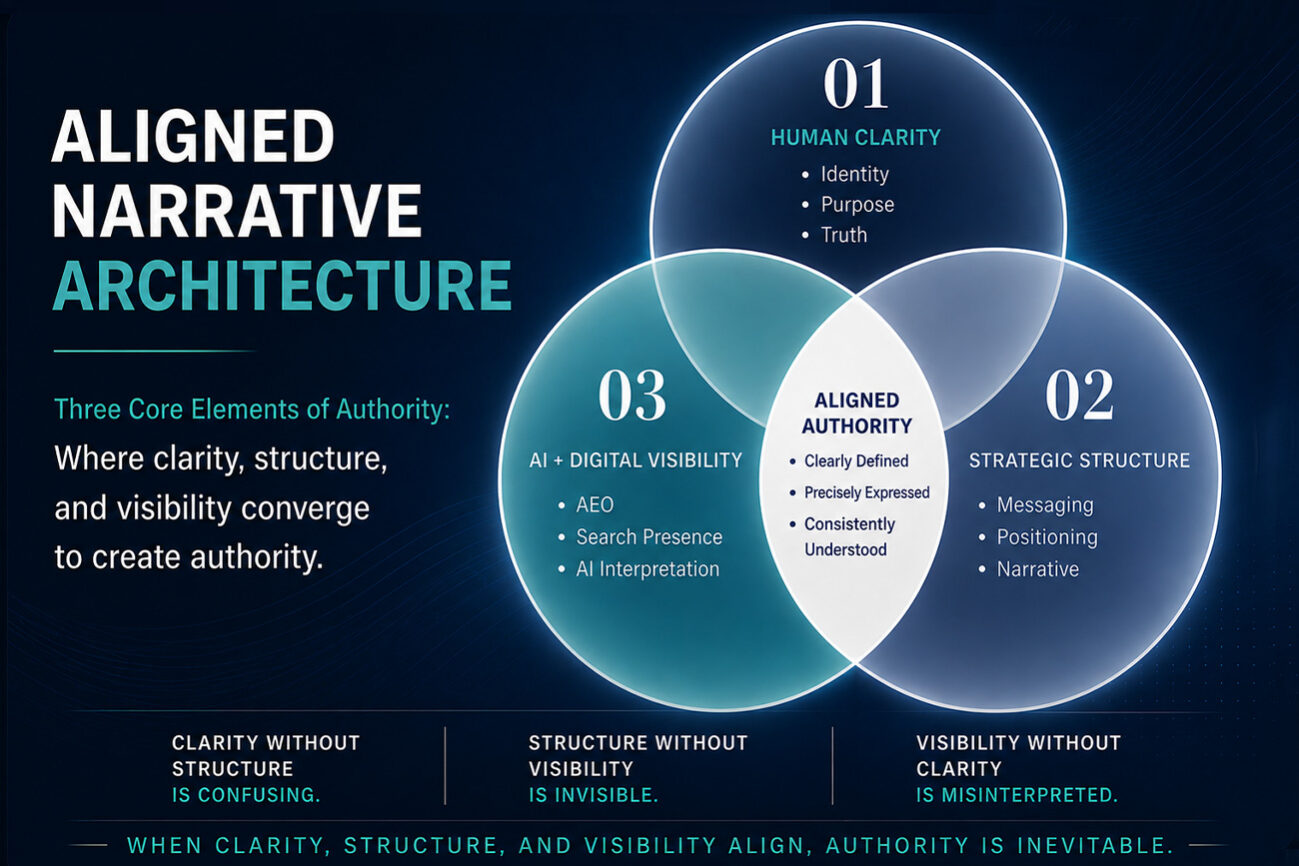
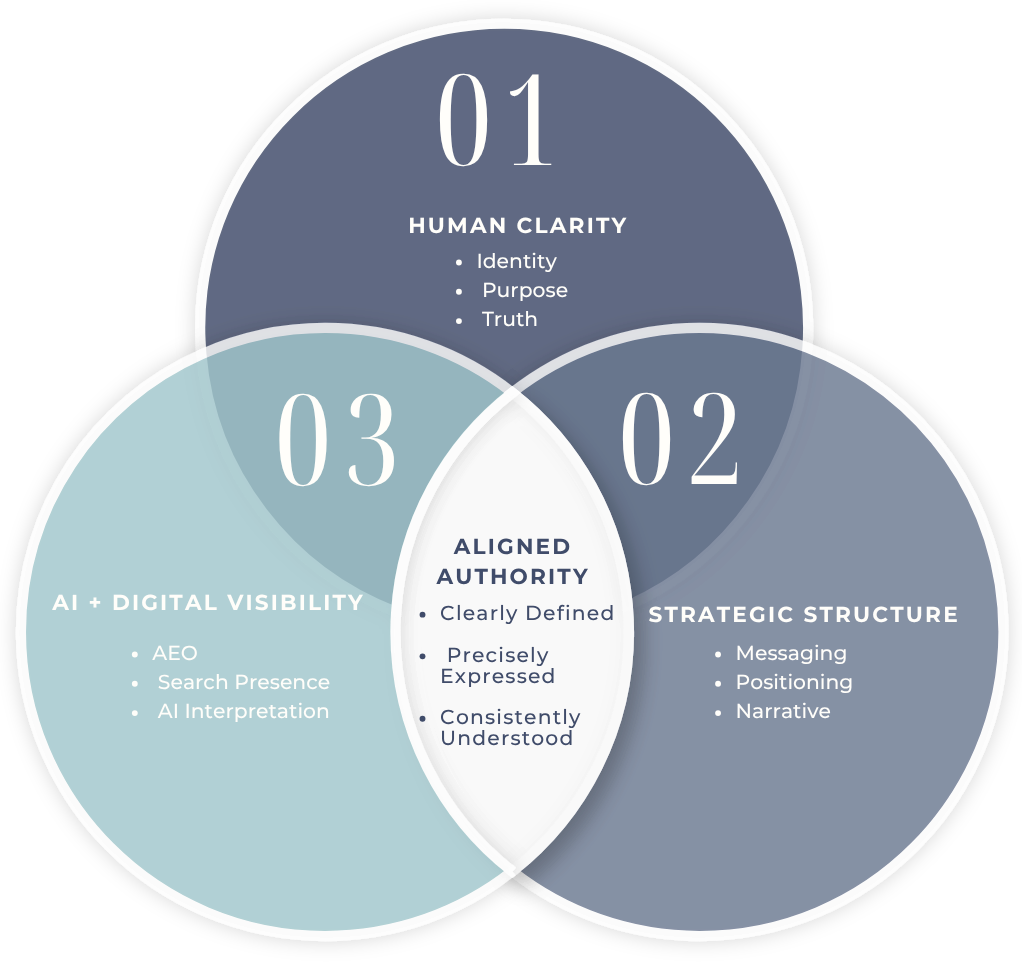
The Three Elements of Aligned Authority
Authority is not created through exposure. It is created through alignment.
There are three elements that must work together.
Human Clarity
Clarity is foundational.
It is not positioning. It is the truth about a brand.
It requires a precise understanding of identity, direction, and conviction. When clarity is defined, everything that follows gains strength. When it is not, everything becomes diluted.
Strategic Structure
Clarity must be translated into a system.
Structure allows your message to be consistently understood, repeated, and scaled. It transforms ideas into a cohesive narrative through intentional messaging and positioning.
Without structure, even the most valuable expertise remains fragmented.
AI and Digital Visibility
Visibility today is not passive. It is constructed.
Your digital presence must be interpretable, structured, and consistent across platforms. This is where AEO becomes essential—not as a tactic, but as a method of aligning human meaning with machine interpretation.
Where Alignment Becomes Authority
When clarity, structure, and visibility align, something shifts.
You are no longer simply present.
You are understood.
You are no longer competing for attention.
You are being selected.
This is the transition from visibility to authority.
Aligned AEO Narrative Architecture
Aligned AEO Narrative Architecture is the system that defines how authority is structured, interpreted, and represented in an AI-driven environment.
It is not a framework for visibility.
It is a system for accurate representation.
At its core, it ensures your expertise is:
- Clearly defined
- Structurally expressed
- Consistently understood
The Role of AI in Reputation
AI is now a primary layer of evaluation.
Before someone engages with you, they engage with your digital narrative—how it is structured, connected, and interpreted.
If that narrative lacks clarity or cohesion, your authority is diminished before the conversation begins.
This is not a matter of exposure.
It is a matter of representation.
From Expansion to Precision
More content does not solve this.
More platforms do not resolve it.
Without alignment, increased visibility amplifies inconsistency.
Authority is not built through expansion.
It is built through precision.
A Necessary Question
Your presence already exists.
Your narrative is already being interpreted.
The question is whether it reflects who you are and what you are here to represent—accurately and consistently.
Final Thought
This is not about controlling perception.
It is about defining truth and structuring it so it can be understood without distortion.
When clarity, structure, and visibility align, you do not need to compete for attention.
You are recognized with precision.
If your narrative is not clearly defined, it is already being interpreted.
If your narrative is not clearly defined, it is already being interpreted.
Frequently Asked Questions
It means that in today’s AI-driven environment, clear and structured communication builds more trust, visibility, and authority than simply producing more content.
AI systems evaluate and interpret content based on structure, consistency, context, and meaning. Clear messaging helps AI better understand and surface your brand online.
AI analyzes website content, search signals, entity relationships, topical consistency, structured data, and overall narrative alignment to form an understanding of a brand.
Narrative architecture is the intentional structure of messaging, positioning, content, and digital presence that shapes how people and AI systems interpret a brand.
Yes. Confusing, inconsistent, or fragmented messaging can reduce trust signals and make it harder for search engines and AI platforms to understand your authority.
Traditional SEO is still important, but AI visibility now also depends on clarity, topical authority, semantic relationships, and structured content that AI systems can interpret accurately.
Businesses can improve AI interpretation by creating clear messaging, structured content, entity alignment, schema markup, consistent branding, and authoritative topical coverage.

Download the Personal Profile Optimization eBook
Take Control of Your Online Narrative eBook — a practical, insight-packed guide to help you take control of how the world (and AI) sees you online.
Whether you’re an executive, business owner, or professional ready to be seen for who you truly are—this guide is your first step.